
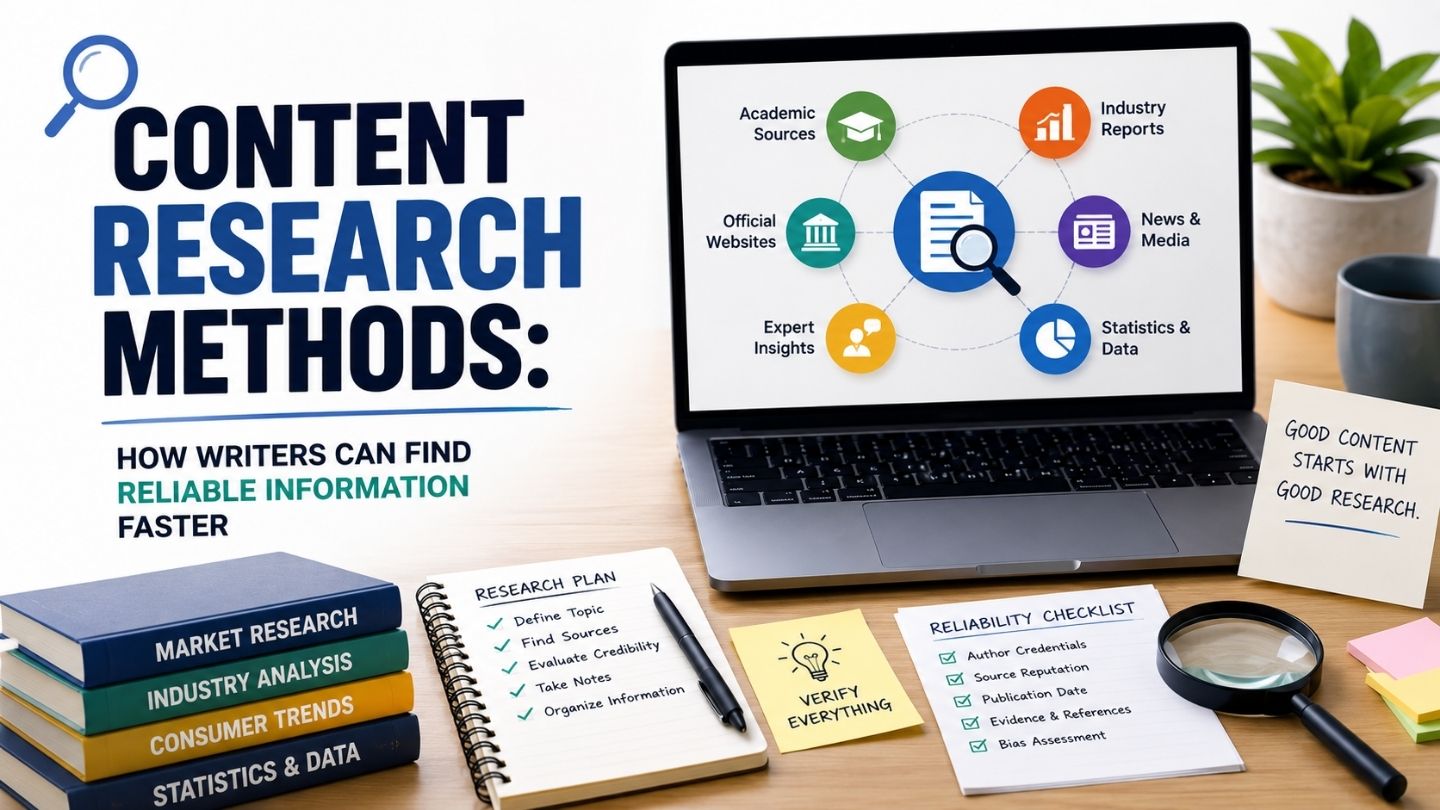
Research is where content quality actually gets decided, long before a single sentence gets written, and it’s also where writers waste the most time chasing sources that turn out unreliable or irrelevant. A faster, more disciplined research process doesn’t just save time; it produces better content, because the writer spends more of their energy on structure and clarity instead of frantically fact-checking after the draft is done. This blog covers a practical approach to finding reliable information quickly, evaluating sources under time pressure, and avoiding the research habits that quietly waste hours.
Key Takeaways
- Primary sources save time later even though they take longer to find first.
- A tiered source hierarchy speeds up evaluation under a deadline.
- Research and writing should be separate phases, not interleaved constantly.
- AI research tools help with speed but require independent verification.
- A reusable source list per topic compounds value over multiple pieces.
What to Do When the Primary Source Is Genuinely Inaccessible
Sometimes the original study sits behind a paywall, or the primary document simply isn’t publicly available, and a writer has to decide how to proceed responsibly. In these cases, citing a credible secondary source while being transparent about the limitation, noting that the claim comes from a source referencing the original rather than the original itself, is more honest than presenting secondhand information as though it were directly verified.
This transparency matters more than it might seem, because a reader or fact-checker who later discovers a claim was sourced secondhand without disclosure loses trust in everything else the piece claims, even material that was properly verified. A brief, honest attribution note costs almost nothing and protects the credibility of the entire piece.
Why Primary Sources Are Worth the Extra Time Upfront

It’s tempting to cite whichever article already summarized a statistic, because it’s faster to find than the original study. That shortcut costs more later than it saves now; secondary sources sometimes misrepresent the original finding, drop important context, or simply get details wrong in ways that then propagate through everyone who cited the summary instead of the source.
Tracking down the original study, report, or primary document takes longer on the first pass and pays off immediately; you can cite it with confidence, quote it accurately, and catch nuance that a secondary summary flattened. Over time, writers who default to primary sources build a mental map of where the reliable original data in their industry actually lives, which makes future research faster rather than slower.
Building a Source Hierarchy for Quick Evaluation
Under deadline pressure, evaluating every source from scratch wastes time that a simple mental hierarchy avoids. Government data, peer-reviewed research, and direct company statements sit at the top, reliable by default unless something specific flags concern. Established industry publications and expert-authored analysis sit in the middle, generally trustworthy but worth a quick check on the author’s actual expertise. Forums, unattributed blog posts, and content farms sit at the bottom, usable for finding leads toward better sources but not for citing directly. This kind of systematic sourcing overlaps with Reddit keyword research for finding what competitors miss, since forums often surface genuine questions before they show up in standard keyword tools.
Having this hierarchy in mind before you start searching means you can triage results quickly rather than deliberating over every single link. See a government or peer-reviewed source, move forward with reasonable confidence. See an unattributed blog claim, treat it as a lead to verify elsewhere rather than a citable fact. This single habit probably saves more research time than any specific tool or shortcut.
Separating Research From Writing
Constantly switching between researching and writing, stopping mid-sentence to verify a claim, breaks flow and makes both tasks slower than doing them in distinct phases. A focused research session that gathers everything needed- sources, quotes, data points, organized loosely by section- followed by an uninterrupted writing session produces faster output and fewer half-finished thoughts than interleaving the two constantly.
This requires slightly more upfront planning, roughly outlining what claims the piece will need to support before researching, rather than researching generally and hoping the right material turns up. But that planning step is quick, and it turns research from an open-ended search into a targeted one, which is considerably faster to execute well.
Keep a Running Doc, Not Scattered Tabs
Dumping quotes, links, and notes into a single running document as you find them, rather than relying on a pile of open browser tabs, means nothing gets lost when your session ends and nothing needs re-finding later.
Where AI Research Tools Genuinely Help
AI tools are useful for the exploratory phase, quickly surveying what’s generally known about a topic, generating a list of likely sub-questions to investigate, or summarizing a long document to decide whether it’s worth reading in full. Used this way, they compress the time spent figuring out where to look, which is often the slowest part of research. Understanding how automated SEO tools work and where they fall short applies the same logic: useful for speed and exploration, unreliable as a final, unverified source.
What they’re not reliable for is being the final source themselves. AI-generated summaries can misstate details or blend sources in ways that produce a plausible-sounding but inaccurate claim, and citing an AI tool’s summary as though it were a verified fact skips the verification step research exists to provide. Use them to find the real sources faster, then verify against those sources directly before anything goes into a draft.
Avoiding Research That Never Converges
Open-ended research without a clear stopping point is a common time sink, particularly on interesting topics where one source leads to another indefinitely. Setting a rough time budget per section before starting, and treating “good enough to support the claim confidently” as the finish line rather than “exhaustively comprehensive,” keeps research proportional to what the piece actually needs.
This matters more for supporting claims than for core arguments. A minor statistic supporting a secondary point doesn’t need the same research depth as your piece’s central claim. Calibrating effort to the weight of the claim, rather than researching everything with equal thoroughness, is where a lot of reclaimable time hides. Reviewing your own content quality checklist for what needs verification before diving in helps set that calibration consistently across a team rather than leaving it to individual judgment each time.
Building a Reusable Source Library
Research on a given topic rarely gets used only once; most content teams return to overlapping subjects repeatedly over months and years. Keeping an organized, searchable log of verified sources by topic, rather than starting from zero each time, turns individual research sessions into a compounding resource rather than disposable effort.
A simple shared document or spreadsheet- topic, source, key finding, link, verified date- is enough to start. Over a year, this becomes genuinely valuable institutional knowledge, faster research for the whole team, and a defense against citing something once current that’s since become outdated, because the verified date flags exactly what needs rechecking before reuse.
Training Newer Writers on the Same Standards

An experienced writer develops source judgment intuitively over years, which is exactly why it’s hard to hand off to someone newer without an explicit framework. Documenting the source hierarchy and the separation between research and writing phases, rather than assuming it’ll be picked up through observation, gets new team members to a reliable standard much faster.
This also protects consistency as a team scales. Without a shared, written standard, research quality varies significantly by individual, and inconsistency in sourcing is one of the harder problems to catch in a final edit, since a plausible-sounding but poorly-verified claim reads exactly like a well-verified one on the page.
Research That Serves the Writing Instead of Slowing It Down
Faster, more reliable research comes from discipline more than from any specific tool, defaulting to primary sources, using a hierarchy to triage quickly, separating research from writing, using AI for exploration rather than final citation, and calibrating effort to what each claim actually needs. Build a reusable source library alongside this, and the whole process gets faster over time rather than starting from scratch on every new piece.
At The Ocean Marketing, we build content writing processes around research that holds up to scrutiny without slowing production to a crawl. Whether you need help building a source hierarchy for your team, auditing existing content for research quality, or a free SEO audit to see how your content is currently performing, our team can help. Contact us and let’s build a research process that actually saves you time.