
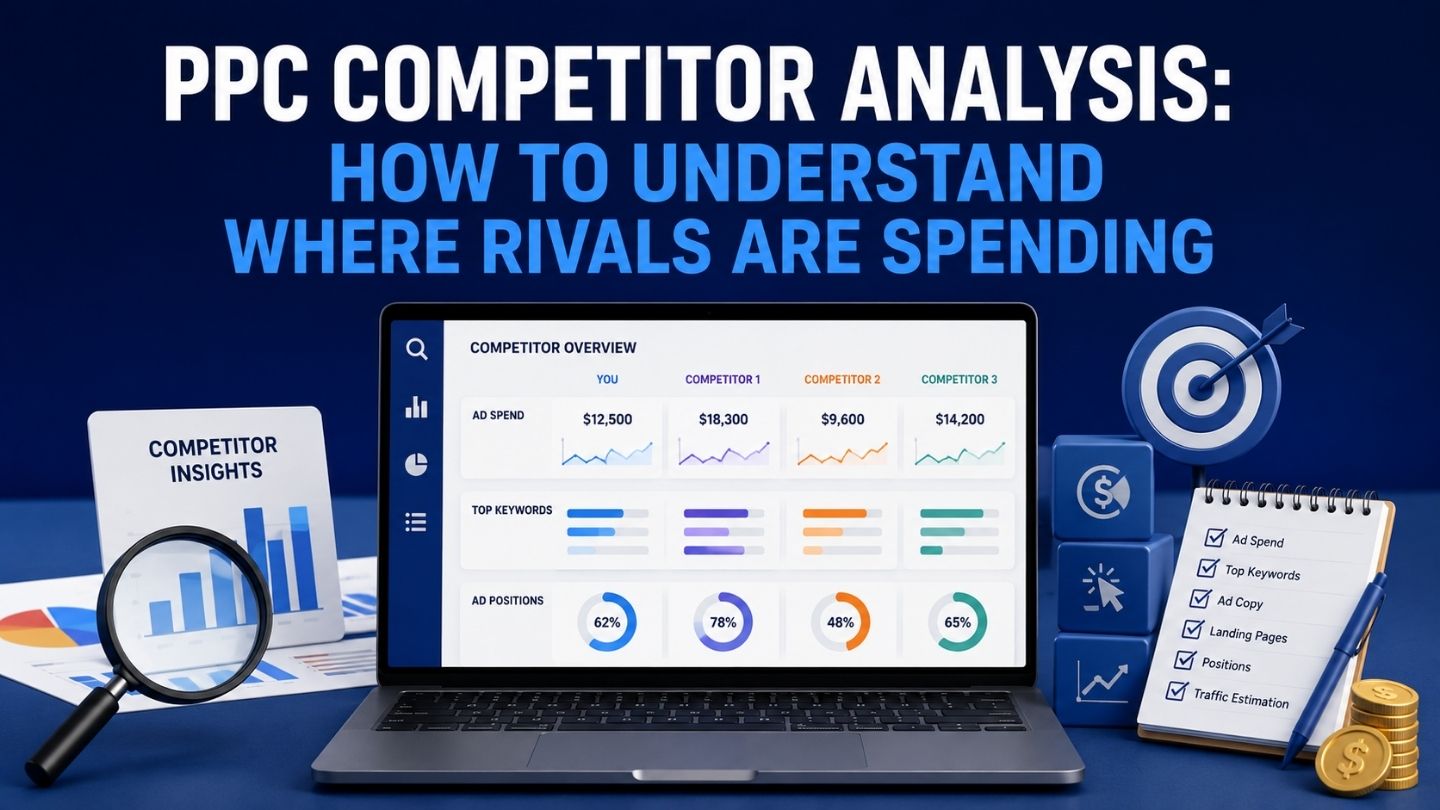
Your cost per click went up, and nothing in your own account changed, which usually means a competitor changed theirs. Paid search is a shared auction, and understanding where rivals are actually spending, on what terms, with what messaging, explains a lot of performance shifts that look mysterious from inside your own dashboard alone. This blog covers the practical methods for analyzing competitor paid search activity, what the data can and can’t tell you, and how to turn it into decisions rather than just interesting observations.
Key Takeaways
- Competitor bidding activity directly affects your own costs, even without you changing anything.
- Ad transparency tools reveal competitor creative without needing account access.
- Estimated spend figures are directional, not precise, and should be treated that way.
- Messaging and offer patterns matter more than exact keyword lists.
- Competitor analysis should feed specific decisions, not just general awareness.
Distinguishing Competitor Activity From Seasonal Patterns
It’s easy to misattribute a cost increase to competitive pressure when the actual cause is seasonal demand shifting the auction dynamics for everyone simultaneously. Checking whether the pattern you’re seeing has historical precedent at the same time of year, before concluding a competitor is the cause, prevents a misdiagnosis that leads to an unnecessary reaction against a competitor who isn’t actually the reason.
Layering seasonal awareness onto competitive monitoring, rather than treating every cost fluctuation as evidence of a rival’s new strategy, produces a more accurate read of what’s actually driving your account’s performance changes.
Why Competitor Activity Shows Up in Your Own Numbers

Paid search is a real-time auction, and every competitor bidding on overlapping terms is directly influencing what you pay, regardless of anything happening within your own account. A new entrant bidding aggressively, an existing competitor increasing budget, or a rival testing new keywords can all show up as a rising cost per click or falling impression share on your end, with no internal cause to point to.
This is why competitor analysis isn’t optional context; it’s often the actual explanation for performance changes that would otherwise look like a mystery. Before assuming a quality score problem or a seasonal shift, checking whether the competitive landscape itself has changed is frequently the faster, more accurate diagnosis, and it’s one internal metrics can’t provide on their own.
Using Ad Transparency Tools
Google’s own ad transparency center, along with similar tools from major ad platforms, lets you see the actual ads a competitor is currently running without needing any access to their account. This reveals their current messaging, offers, and creative approach directly, which is considerably more reliable than guessing based on what shows up when you happen to search a shared term.
Checking this periodically for your main competitors reveals patterns worth noting: are they consistently testing new offers, do they run seasonal promotions on a predictable schedule, has their core messaging shifted recently? This is genuinely useful competitive intelligence available for free, and most businesses never check it despite how directly it applies to campaigns they’re actively running.
Reading Estimated Spend and Keyword Data Correctly
Third-party paid search intelligence tools can estimate a competitor’s monthly spend, top keywords, and ad copy history, and it’s worth being clear-eyed about what these numbers actually are: estimates based on visible auction activity and typical cost patterns, not verified figures pulled from the competitor’s actual account. Treat them as directionally useful rather than precisely accurate.
What’s more reliable within that data is the relative pattern rather than the absolute number: whether a competitor’s estimated spend and keyword count are trending up or down over time, which terms consistently appear in their portfolio versus which are new or recently dropped. That trend information tends to hold up better than any single spend figure taken at face value, and it’s usually what actually matters for your own decisions.
Cross-Reference Multiple Sources
Different competitive intelligence tools often produce noticeably different estimates for the same competitor. Checking more than one source and looking for where they broadly agree gives a more reliable picture than trusting a single tool’s number.
What Messaging Patterns Actually Reveal
Beyond keywords and spend, the actual language competitors use in their ads often reveals more about their strategy and positioning than the technical data does. Are they leading with price, with speed, with a specific guarantee? Consistent patterns across their ad copy over time suggest a deliberate positioning choice worth understanding, whether you decide to differentiate against it or match it.
This connects directly to broader thinking about what factors influence paid campaign success, since messaging and offer strategy often matter as much as bid amount for actual performance. A competitor winning auctions with a lower bid but stronger, more specific ad copy is teaching you something about relevance and message match that a pure spend comparison would miss entirely.
Turning Analysis Into Actual Decisions
Competitor research that stays as interesting background information without changing any actual decision is wasted effort. Each finding should map to a specific action: a competitor consistently outbidding you on a core term might justify a bid increase, a budget reallocation, or a decision to deprioritize that term and focus elsewhere depending on its actual value to your business. This is closely related to audience exclusions as an overlooked paid search optimization; competitor pressure on a term sometimes means it’s time to exclude an audience segment rather than simply outbidding.
A competitor’s strong messaging pattern might justify testing similar positioning, or deliberately differentiating against it if their approach reveals a gap they’re not addressing. The point of the research is always the decision it enables, not the observation itself, and it’s worth explicitly connecting each finding to what you’ll actually do differently before moving on to the next competitor.
Coordinating Competitor Insights With the Rest of the Marketing Team
PPC competitor findings frequently reveal something relevant beyond the paid channel itself: a messaging angle a competitor is testing, an offer structure gaining traction, a positioning shift worth noting. Sharing these findings with whoever handles broader marketing strategy, not just keeping them within the paid search function, ensures the intelligence gets used more broadly than a single channel’s bid adjustments.
This coordination also prevents the common situation where paid search and organic or content teams are independently tracking the same competitors without comparing notes, duplicating effort that a shared, simple summary could consolidate into something more useful for the whole marketing function.
How Often This Analysis Is Worth Doing

A thorough competitor review doesn’t need to happen constantly; campaigns and messaging don’t usually shift dramatically week to week. A monthly or quarterly review, checking ad transparency tools and spend estimate trends for your main two or three competitors, catches meaningful shifts without becoming a time sink that distracts from managing your own campaigns.
The exception is during a period of unexplained performance change in your own account: a sudden cost increase or impression share drop is worth an immediate competitive check rather than waiting for the next scheduled review, since it’s often the fastest path to understanding what actually happened. Reviewing when to pause or optimize underperforming campaigns alongside this competitive check gives a fuller picture than either check alone.
Knowing When Not to React to a Competitor
Not every competitive movement deserves a response. A rival testing a new keyword for two weeks before abandoning it isn’t a signal worth matching, and reacting to every visible fluctuation in a competitor’s activity turns account management into a constant, exhausting chase rather than a deliberate strategy. Distinguishing a sustained shift from a short-lived test matters as much as spotting the change itself.
A reasonable rule: wait to see whether a competitor’s change persists across at least a few weeks before adjusting your own strategy in response. Short-term reactions to what turns out to be a brief experiment on their end usually cost more in wasted adjustment than the risk of a slightly delayed response to something genuinely sustained.
Understanding the Auction You’re Actually In
PPC performance never happens in isolation, and understanding where competitors are spending, what they’re saying, and how their activity is shifting explains a meaningful share of performance changes that look confusing from inside your own account alone. Use transparency tools and spend estimates as directional intelligence rather than precise numbers, and make sure every finding connects to an actual decision rather than staying interesting background you never act on.
At The Ocean Marketing, we build PPC strategies informed by the real competitive landscape, not just internal account metrics. Whether you need help running a proper competitor analysis, understanding a recent cost increase, or a free SEO audit to see how your paid and organic efforts fit together, our team can help. Contact us and let’s find out what’s actually happening in your auction.