
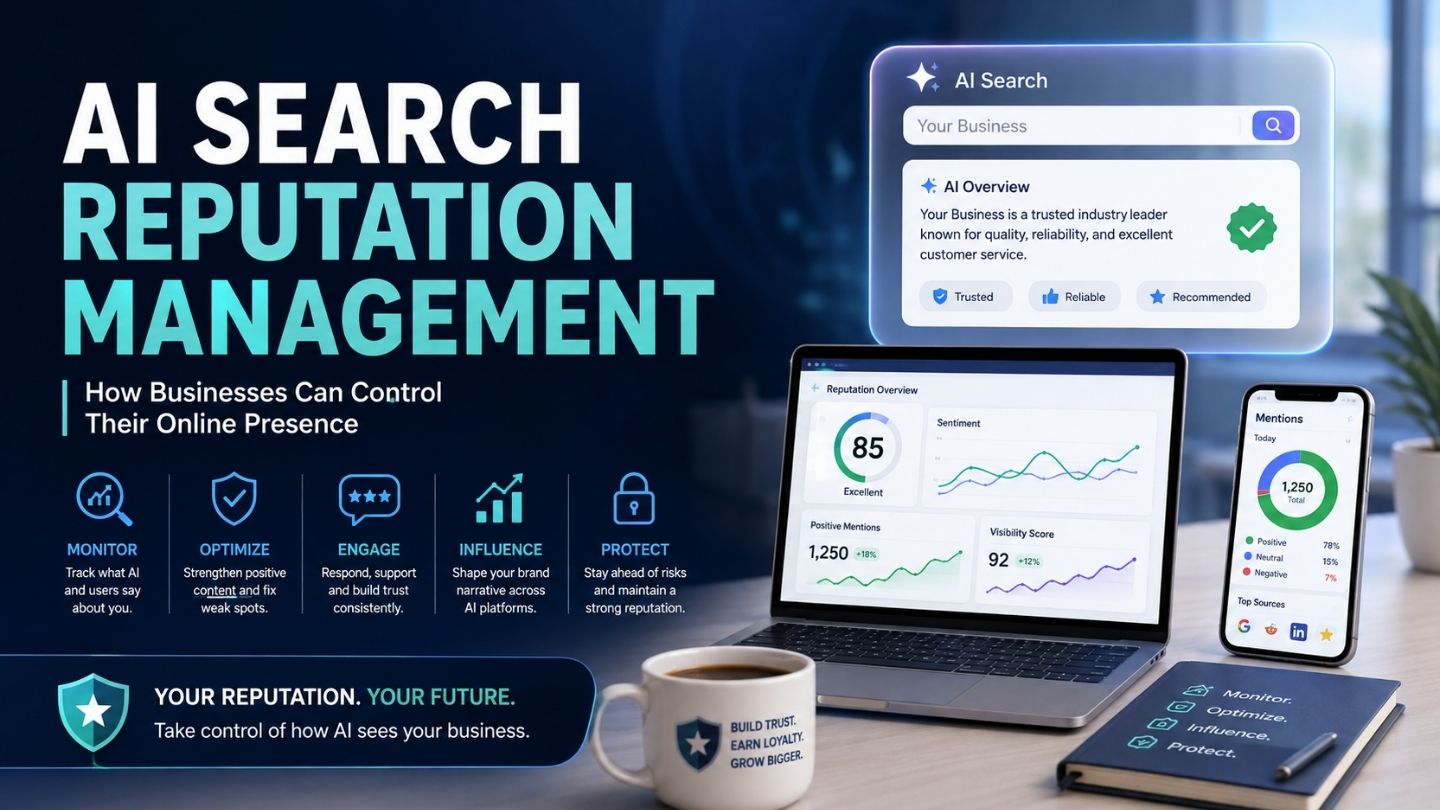
Reputation management used to mean monitoring reviews and search results. Now it also means monitoring what AI systems say about your business when someone asks directly, and that’s a much harder thing to control, because you can’t edit an AI-generated summary the way you might respond to a review. Businesses that ignore this are finding out what AI search says about them from a customer rather than from active monitoring. This blog covers how AI search reputation actually works, what genuinely influences it, and the practical steps for managing it before a problem surfaces publicly.
Key Takeaways
- AI-generated answers about your business can differ meaningfully from search results.
- The system draws from a broad mix of sources, not just your own website.
- Outdated or inaccurate information can persist in AI answers longer than expected.
- Consistent, verifiable information across the web is the main lever you have.
- Monitoring needs to be active and periodic, not reactive.
Why This Matters More for Some Industries Than Others
Businesses in sensitive or trust-dependent industries, healthcare, finance, and legal services, have more at stake in how AI systems characterize them than a business selling a straightforward, low-consideration product. A slightly inaccurate AI summary about a coffee shop costs little. The same kind of inaccuracy about a financial advisory firm or a medical practice can meaningfully affect whether someone trusts the business enough to make contact.
This means the level of monitoring and active management this deserves should scale with how consequential a mischaracterization would actually be for your specific business, rather than applying the same light-touch approach universally regardless of industry.
Why AI Answers Can Differ From Search Results
A traditional search for your business name returns a list of links- your site, review platforms, social profiles- letting a searcher form their own impression across multiple sources. An AI search response synthesizes those same sources into a single narrative answer, which means the system is making editorial choices: what to include, what to emphasize, and how to characterize you- something a plain results list never did.
This synthesis can produce genuinely different impressions than the underlying sources would individually give. A business with mostly positive reviews and one prominent negative story might get characterized in ways that overweight the negative story if it happens to be more recent or more heavily cited elsewhere, simply because the system is trying to construct a balanced-sounding summary rather than presenting raw source material for a person to weigh themselves.
What the System Is Actually Drawing From

AI search answers about a business typically draw from a mix of your own website, review platforms, news coverage, social mentions, and any other content across the web that references you. Unlike a traditional search result, which a person actively clicks through and evaluates source by source, this mix gets blended into a single answer without necessarily flagging which claims came from where or how reliable each source actually is. This is why perfect five-star reviews can sometimes hurt a business; an implausibly flawless record reads as less credible to both people and the systems synthesizing it.
This means content you don’t directly control- an old news article, an outdated directory listing, a negative review from years ago- can still meaningfully shape how you’re characterized in an AI answer today, even if the situation has long since changed. Reputation management in this context means paying attention to the full mix of sources feeding the system, not just your own owned properties.
The Persistence Problem
Outdated information can persist in AI-generated answers longer than a business owner expects, particularly if the outdated source is well-established or frequently cited elsewhere. A business that resolved a customer service issue years ago might still find an AI summary referencing an old complaint, because the underlying source article never got updated or removed and the system has no inherent way of knowing the situation changed.
This is a genuinely harder problem than managing a single review platform, because there’s no direct “edit” button for an AI-generated characterization the way there might be for a listing you control. The lever available is influencing the underlying sources, publishing current, accurate information consistently enough and prominently enough that it outweighs the outdated source in whatever the system is drawing from.
Check What’s Actually Being Said Regularly
Run your own business name through AI search surfaces periodically and read the actual characterization, not just whether you appear. Catching an inaccurate or outdated summary early gives you time to address it before a customer encounters it first.
The Levers You Actually Have
Consistency across owned and earned properties is the strongest lever available. Your website, your social profiles, your review responses, and any press or industry coverage should tell a coherent, current story about your business. Contradictions or gaps across these sources give the system less to confidently synthesize, and confident, consistent signals tend to shape the resulting characterization more reliably than scattered or contradictory ones.
Actively responding to reviews, particularly negative ones, matters more in this context than it might have previously, because a thoughtful, resolved-sounding response can shift how that review factors into a synthesized summary, versus an unanswered complaint that sits as the only visible word on the matter. This connects to why reasons a Google Business Profile might get suspended matter here too; unnatural-looking review patterns draw scrutiny from both platforms and AI systems alike.
Building Current, Citable Content About Your Business
Publishing clear, current information about your business, updates, case studies, and accurate service descriptions gives AI systems recent, reliable material to draw from rather than leaving older, less accurate sources as the most prominent option. This isn’t fundamentally different from good optimization practice, but it takes on added importance specifically because AI synthesis tends to favor clear, well-attributed, current information when it’s available. This connects directly to broader E-E-A-T optimization and building authority in your niche; the same signals that build traditional trust feed directly into how confidently AI systems characterize you.
This also means entity clarity matters here in the same way it matters for AI search visibility generally; a business the system can confidently identify and verify tends to get a more accurate, current characterization than one whose identity is ambiguous or poorly established across the sources feeding the answer.
Monitoring as an Ongoing Practice
Reputation management in AI search can’t be a one-time check, because the underlying sources and the system’s synthesis both change over time, sometimes without any obvious trigger. Building a regular habit of checking how your business is actually characterized across the major AI search surfaces, quarterly at minimum, catches drift or inaccuracy while it’s still a small, manageable correction rather than an established narrative a customer encounters before you knew there was a problem.
Keep a simple record of what you find each time, noting any inaccuracies or outdated claims, so you can track whether corrections are actually taking hold over subsequent checks or whether a persistent source keeps resurfacing the same issue. That record also gives you something concrete to act on rather than a vague sense that something might be off.
Working With Journalists and Reviewers Proactively

Since AI systems draw heavily from published third-party content, cultivating relationships with journalists and reviewers who cover your industry gives you some influence over what current, accurate sources exist to be drawn from. A recent, well-sourced article characterizing your business accurately can meaningfully outweigh an older, less flattering source in whatever mix the system is synthesizing.
This connects directly back to the newsjacking and original research approaches covered elsewhere: being a genuinely useful, responsive source for journalists doesn’t just earn traditional coverage and links; it actively shapes the pool of current, accurate material available for AI systems to draw from when someone asks about your business.
Managing a Reputation You Can’t Directly Edit
AI search reputation management means accepting that you can’t directly control the summary a system produces, only the underlying sources feeding it, and working to make those sources consistent, current, and clearly attributed to your actual business. Monitor regularly, respond to reviews thoughtfully, keep your owned content current, and treat entity clarity as part of the reputation work rather than a separate technical concern. The businesses managing this well are finding out about problems from their own monitoring, not from a customer.
At The Ocean Marketing, we help businesses build SEO and content strategies that keep their online presence accurate and current across every source AI systems draw from. Whether you need help auditing how your business currently appears in AI search, building a monitoring routine, or a free SEO audit to see where your site stands, our team can help. Contact us and let’s find out what AI search is actually saying about your business.