
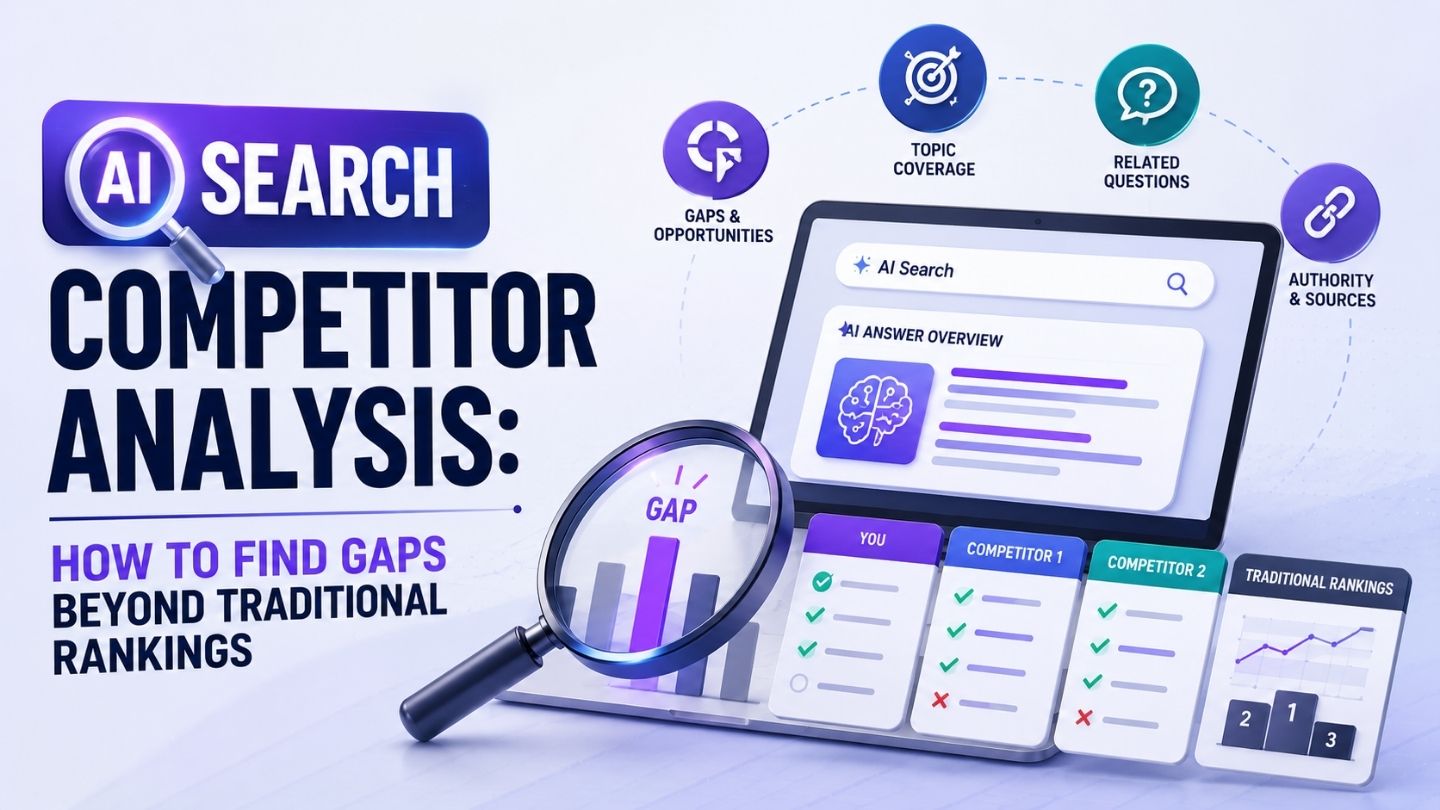
Traditional competitor analysis checks who ranks above you and why. That’s still worth doing, and it’s no longer the whole picture, because a competitor can be losing traditional rankings to you while quietly dominating every AI-generated answer in your category. Missing that gap means missing where a growing share of your potential customers are actually forming their first impression of who the credible options are. This blog covers how to analyze competitors in AI search specifically, what to look for beyond rankings, and how to find gaps traditional tools won’t show you.
Key Takeaways
- AI search visibility and traditional rankings are increasingly separate metrics.
- Manual query testing across AI platforms reveals gaps no tool fully automates yet.
- Competitors can dominate AI citations while ranking lower traditionally.
- Entity clarity and structured content explain much of the gap when it exists.
- Tracking this requires a repeatable manual process, not a one-time check.
Setting Realistic Expectations for This Kind of Analysis
It’s worth being upfront that AI search competitor analysis, done manually, will never be as precise or comprehensive as a mature rank tracking tool, and holding it to that standard sets an unrealistic bar that discourages doing it at all. The value comes from directional insight, consistently checked over time, not from a perfectly comprehensive single report.
Treating this as an ongoing, imperfect practice that improves your understanding incrementally, rather than a one-time project that needs to produce a definitive answer, matches the actual maturity of the tooling available right now and keeps the effort proportional to what it can realistically deliver.
Why Traditional Tools Miss This Entirely

Rank tracking tools were built to monitor position on a results page, a well-defined, stable thing to measure. AI-generated answers don’t have an equivalent stable position to track; a system might cite you prominently for one phrasing of a query and not mention you at all for a near-identical phrasing, and there’s no single number that captures that variability the way a rank position does.
This means the gap between traditional and AI visibility can hide in plain sight. A business checking only its rank tracker has no idea whether it’s being cited, ignored, or actively contradicted within AI answers for its core topics, and neither does it know how a competitor is performing on that same invisible metric. The tooling simply hasn’t caught up to measuring this as cleanly as it measures traditional rank.
Running the Manual Query Comparison
Until the tooling matures, the most reliable method is direct, manual testing. Take your core business queries, the ones a genuine prospect would ask, and run them through the major AI search surfaces yourself, noting who gets cited, how they’re characterized, and what specific content gets referenced or quoted in the answer. This kind of manual comparison work pairs naturally with a traditional competitor analysis to find who’s actually competing for your traffic, since the two lists rarely match exactly.
Do this for both your own queries and a handful of your competitor’s, comparing not just whether each business appears but how confidently and how prominently. A competitor mentioned once in a list of options is in a very different position than one whose specific data or explanation gets directly quoted as the answer’s foundation. That distinction matters more than simple presence or absence.
Why Competitors Sometimes Win Here While Losing Traditionally
It’s genuinely common to find a competitor ranking below you traditionally while dominating the AI answer for the same query, and the reason usually traces back to structure and entity clarity rather than raw content quality. A page that states its answer plainly, in extractable, self-contained passages, gets pulled into AI answers more readily than a longer, more traditionally optimized page that buries its point.
Checking how AI-driven search understands content context through entities against a competitor’s site often reveals the actual cause: they’ve established a clearer structured identity, and their content answers questions more directly, even if their traditional backlink profile and domain authority are weaker than yours. The gap isn’t about who deserves to win; it’s about who’s easier for the system to confidently cite.
Look at Exactly What Gets Quoted
When a competitor is cited, note the specific sentence or statistic being pulled. That tells you precisely what kind of content the system found extractable, which is more useful than knowing they simply “appeared.”
Avoiding the Trap of Chasing Every Single Gap at Once
Once a thorough comparison surfaces several content gaps simultaneously, the temptation is to address all of them immediately, which usually means doing none of them particularly well. Prioritizing based on which gaps affect your highest-value queries, the ones most directly tied to actual business outcomes, produces better results than working through the full list in the order it happened to surface.
A gap in a rarely-searched, low-intent query matters far less than a gap in a query someone asks right before making a purchase decision. Ranking gaps by their proximity to actual conversion, not just by how large or obvious they appear in the comparison, keeps the follow-up work focused on what will actually move the business rather than what’s simply easiest to fix first.
Finding the Specific Content Gaps

Once you’ve mapped who’s winning which queries in AI answers, look for the pattern behind it rather than treating each result as isolated. Are competitors consistently winning definitional queries because their explainer content is more direct? Are they winning comparison queries because they’ve built dedicated comparison pages you haven’t? The pattern, not any single query, tells you where to actually invest.
This is where the analysis becomes genuinely actionable rather than just informative. A gap in comparison content is a content project. A gap in entity clarity is a structured data project. A gap in extractability across otherwise strong content is a formatting and restructuring project. Diagnosing which type of gap you’re facing determines the fix, and lumping them all together as “AI search isn’t working for us” doesn’t get you any closer to solving it.
Building This Into a Repeatable Process
AI systems and their outputs change faster than traditional search results do, which means a one-time competitor check goes stale quickly. Build a short, repeatable list of your core queries and rerun the comparison monthly or quarterly, tracking whether your citation presence is improving, holding steady, or losing ground to specific competitors over that period. Reviewing competitor backlink replication strategies alongside this process helps connect AI citation gaps back to the underlying content and authority patterns driving them.
Keep it lightweight enough to actually sustain. A spreadsheet with your core queries, who’s cited, and a brief note on what content is being pulled is more valuable maintained consistently than an elaborate one-time report that never gets updated. The direction of change over several checks matters more than any single snapshot.
Sharing Findings With the Rest of the Team
AI search visibility findings tend to stay siloed with whoever ran the check, when they’re actually relevant to content, PR, and product teams who could act on the specific gaps identified. A competitor consistently winning comparison queries is useful information for whoever plans content, not just for whoever happens to run technical reporting.
Building a short recurring summary- what’s changed since the last check, which competitors are gaining or losing citation presence, what content gaps were identified- and circulating it beyond the search team turns an isolated audit into something the wider business can actually act on.
Competing on a Metric That’s Still Taking Shape
AI search competitor analysis is genuinely more manual and less precise than traditional rank tracking right now, and that’s not a reason to skip it; it’s a reason to build the habit early while most competitors still aren’t checking either. Understanding where you’re being cited, where a competitor is winning citations you should be earning, and why, gives you a real advantage in a channel that’s shaping first impressions, whether or not your analytics currently capture it.
At The Ocean Marketing, we help businesses build SEO strategies that account for AI search visibility alongside traditional rankings. Whether you need help running a proper AI competitor comparison, closing the structural gaps that are costing you citations, or a free SEO audit to see where your site currently stands, our team can help. Contact us and let’s find out where you’re actually losing ground.